The Shared Architectures: Brain and Cosmos
Exploring the structural, statistical, and informational similarities between neural networks and the cosmic web
Interactive Morphological Analysis
Connectivity Density
Clustering Coefficient
Hierarchical Index
Information Theory Explorer
Network Topology Analyzer
Average Path Length
3.2 stepsNetwork Diameter
7 stepsModularity Score
0.84Emergence Simulator
Cross-Scale Correlation Explorer
At this scale comparison, structural patterns show remarkable similarity in their statistical distributions and organizational principles.
Comparative Statistics
Scale Counts
Human Brain Neurons: ~100 Billion
Observable Universe Galaxies: ~100 Billion
 The total number of neurons in the human brain is similar to the number of galaxies in the observable universe.
Connections & Information
Brain Connections: ~100 Trillion
Human Brain Memory: ~2.5 Petabytes
Cosmic Web Simulation Data: ~1-10 Petabytes
This similarity suggests the information stored in a human brain is comparable in magnitude to that needed to describe the universe's large-scale structure.
Scale Difference
Despite structural similarities, the physical scale of the brain (micrometers to centimeters) and the cosmic web (billions of light-years) differs by approximately 27 orders of magnitude.
Visual Structural Similarity
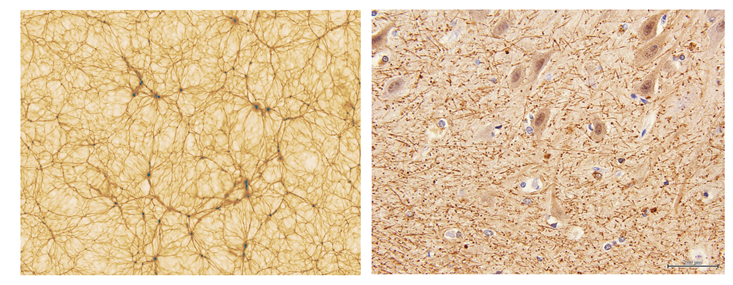 Visual comparison showing a simulated cosmic matter distribution (left) and a slice through the human cerebellum (right), highlighting striking structural resemblances.
Left: Simulated cosmic matter slice - 1 billion light-years across
Right: Human cerebellum slice - 4 micrometers thick
Power Spectrum Analysis
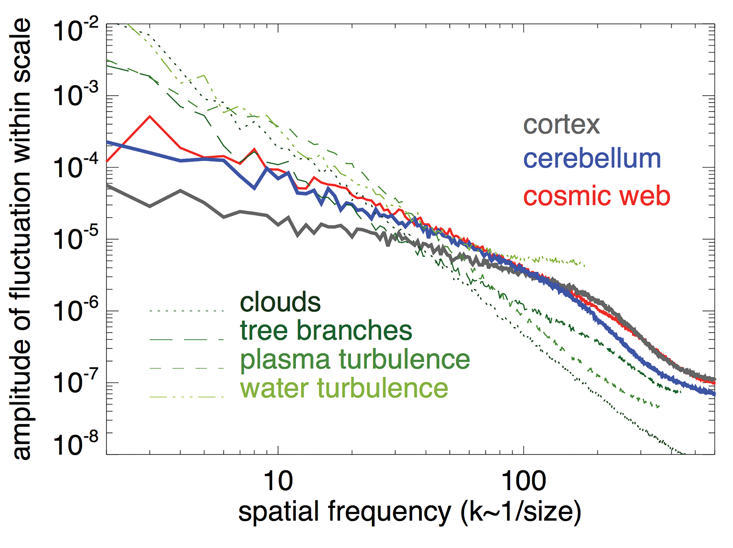
Power spectrum analysis, which measures structural fluctuations across different scales, reveals that the distribution of these fluctuations in the neuronal network and the galaxy network is remarkably similar. This pattern is distinct from fractal systems like clouds or tree branches, suggesting that both the brain and cosmic web are scale-dependent, self-organized structures, not simple fractals.
Scale-Specific Morphological Similarities
- At 0.1-1 mm scales, structural fluctuations in the cerebellum are reminiscent of galaxy distribution patterns observed on scales of hundreds of billions of light-years.
- At scales of about 10 micrometers, the morphology of the cerebral cortex closely matches the morphology of galaxy distributions on scales of a few hundreds of thousands of light-years.
Generating neural networks and cosmic structures...